
Small fixes before big failures
Crack Sealing & Patching in Arlington Heights, IL
Seal the cracks, rebuild the failed spots, and the rest of the pavement lasts longer.
- Estimates on site, at no cost
- Village permit paperwork prepared with your quote
- Thickness, base and scope itemized line by line
Stopping Water Before Winter
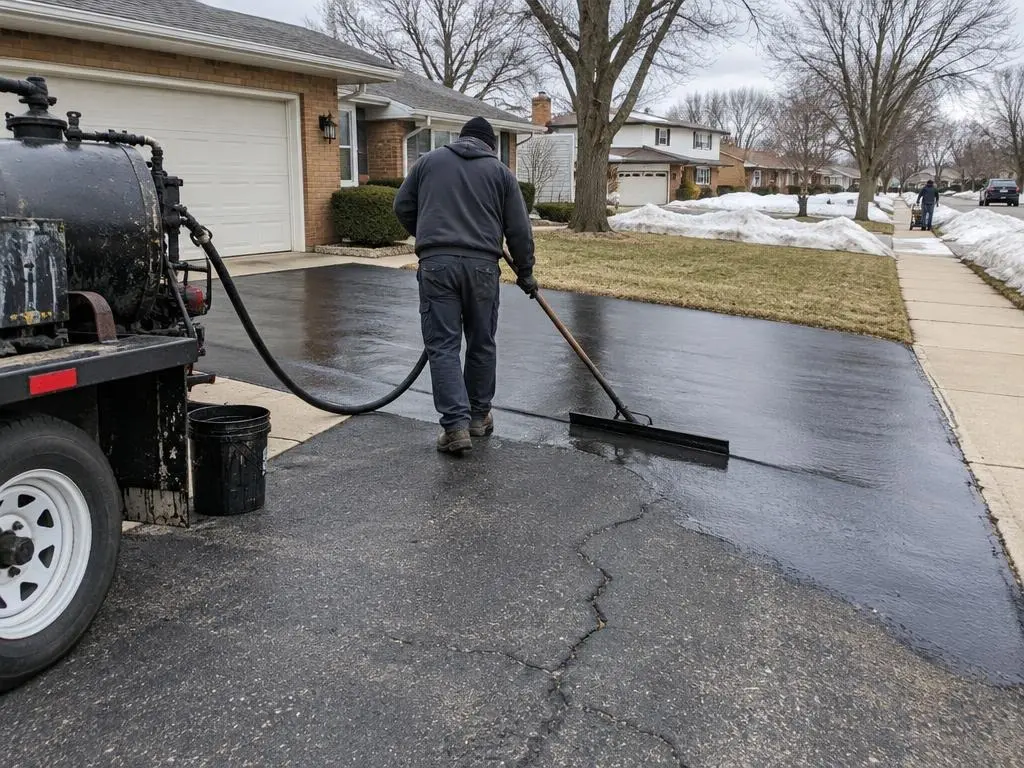
Crack sealing and patching are the two repairs that keep a driveway or lot from sliding into replacement. Crack sealing fills open cracks with a hot, flexible, rubberized sealant so water cannot reach the base. Patching cuts out failed areas such as potholes, sunken spots and broken edges and rebuilds them with new base and hot-mix asphalt. Done on time, both cost far less than the damage they prevent.
Why timing matters
In the northwest suburbs, the average January high is below freezing. Water in an open crack freezes and expands, widening the crack; in spring it softens the base below. Sealing cracks in late summer or fall, before freeze-up, keeps the most water out over the winter. Spring is when potholes appear, and the right time to patch them is once the ground has thawed and dried.
Crack sealing
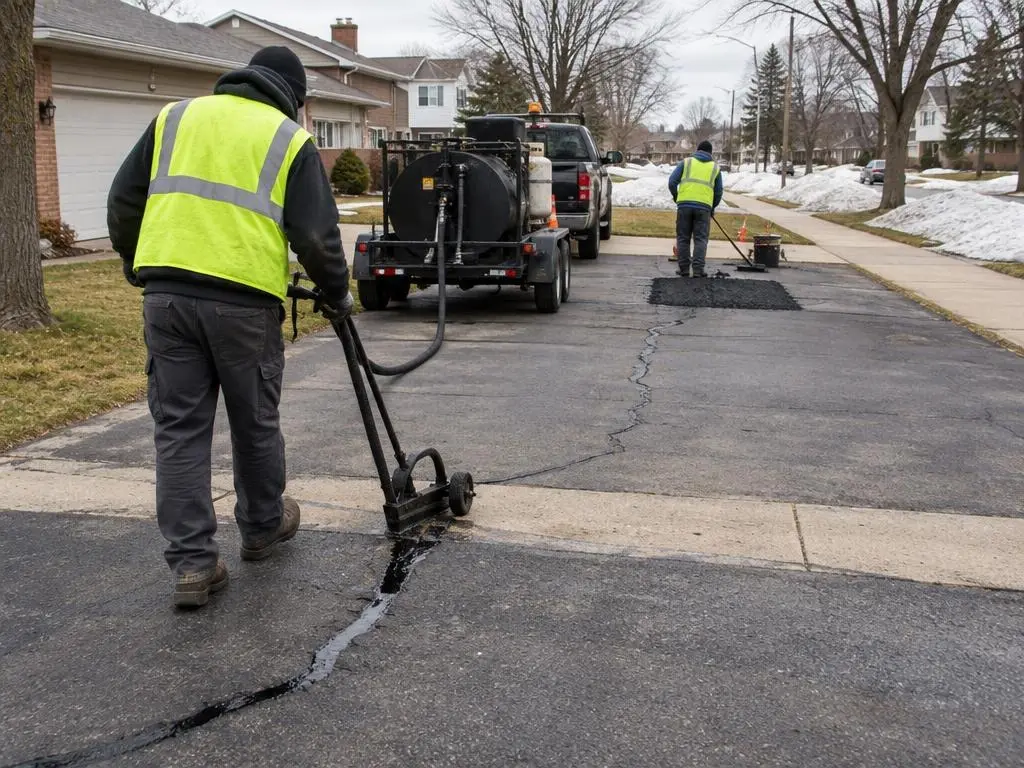
Cracks are cleaned out with air or a heat lance. Working cracks may be routed into a clean channel. Hot sealant is applied and finished flush or with a slight band. It stays flexible through temperature swings. Alligator cracking, a dense web of cracks, signals base failure and needs a patch instead.
Patching options
- Saw-cut patch: failed area cut square, removed, base rebuilt and compacted, new hot mix placed and rolled. The lasting fix.
- Infrared repair: existing asphalt heated and reworked with fresh material; good for surface damage on a firm base.
- Cold patch: temporary winter fill until a proper repair.
- Edge repair: broken edges cut back and rebuilt with support.
Patch or replace?
Scattered failures are worth patching. When failures cover much of the surface or keep multiplying, the base is giving out overall, and replacement or resurfacing is better value. We price both options when it is close.
For associations and businesses
Condo associations, churches and businesses can have cracks sealed and patches done in sections, then sealcoated and restriped in the same season.
Why spring is so hard on pavement
When frost leaves the ground from the top down, water trapped in the base cannot drain into the still-frozen soil below. The base is saturated and weak, and loads that would do little damage in summer break it apart. That is why potholes appear in March and April.
Fixing the cause
At the estimate we look for why each area failed: a downspout dumping onto the pavement, a low spot that holds water, a settled utility trench. Fixing the cause is part of the quote when possible.
Repairs before sealing
If you are planning a sealcoat, crack sealing and patching come first. Sealer is too thin to fill cracks or hold a failed patch together, so the repairs need to be done and set before the coat goes on.
Utility trench settlement
Water, sewer, gas and fiber trenches across driveways sometimes settle years after they were backfilled, leaving a sunken line. We cut out the strip, recompact or replace the fill and repave it level.
What This Covers
Repairs matched to the cause.
Hot crack sealing
Rubberized sealant in cleaned, routed cracks.
Pothole repair
Holes cut square and rebuilt with base and hot mix.
Settled areas
Sunken spots and trench lines rebuilt to grade.
Edge repair
Crumbled edges rebuilt with base support.
Typical Repair Costs
| Repair | Published range |
|---|---|
| Crack filling (HomeGuide) | $0.50 to $3 per linear ft |
| Pothole repair (HomeGuide) | $100 to $400 |
| Hot patch (HomeGuide) | $2 to $5 per sq ft |
| Saw-cut patch (HomeGuide) | $4 to $12 per sq ft |
| Minimum fee (HomeGuide) | $100 to $250 |
National published ranges for planning only. Chicago-area pricing, access, base condition, permit work and season all affect the final number. Your written estimate is the price.
How It Works
1. Survey
Map cracks and failures and their causes.
2. Clean and cut
Cracks cleaned; failed areas cut out.
3. Seal and rebuild
Sealant applied; base and asphalt rebuilt.
4. Follow-up
We note when a sealcoat would help.
Crack Sealing & Patching Questions
When should I seal cracks?
From August into autumn, ahead of the first hard freeze.
How long does crack sealant last?
Several seasons in a well-prepared crack. New cracks appear as pavement ages, so check yearly.
Will patches match?
New asphalt is darker at first. A sealcoat after patches cure evens out the color.
Can you patch in winter?
Only temporarily with cold patch. Permanent repairs wait for thawed, dry ground.
Crack Sealing & Patching Service Areas
- Asphalt Paving in Arlington Heights, IL
- Asphalt Paving in Mount Prospect, IL
- Asphalt Paving in Palatine, IL
- Asphalt Paving in Rolling Meadows, IL
- Asphalt Paving in Prospect Heights, IL
- Asphalt Paving in Buffalo Grove, IL
- Asphalt Paving in Wheeling, IL
- Asphalt Paving in Des Plaines, IL
- Asphalt Paving in Elk Grove Village, IL
- Asphalt Paving in Schaumburg, IL
- Asphalt Paving in Hoffman Estates, IL
- Asphalt Paving in Streamwood, IL
- Asphalt Paving in Park Ridge, IL
- Asphalt Paving in Niles, IL
- Asphalt Paving in Glenview, IL
- Asphalt Paving in Northbrook, IL
- Asphalt Paving in Long Grove, IL
- Asphalt Paving in Lake Zurich, IL
- Asphalt Paving in Vernon Hills, IL
- Asphalt Paving in Barrington, IL
Get a Crack Sealing & Patching Estimate
Book crack sealing before winter. Free estimates.